
Industrial humidification solutions from Ikeuchi
Ikeuchi supplies different types of industrial humidifiers and complete Dry Fog humidification systems for manufacturing and controlled environments. Our range includes AKIMist® humidifiers for local humidity control and AirAKI® systems for larger production areas. We serve industries including electronics, printing, textiles, food processing and horticulture, helping maintain suitable humidity levels while reducing static electricity and dryness-related production problems.
What kind of industrial humidifiers are on the market?
There are several different types of industrial humidifiers on the market depending on the application and needs. Each type has its own benefits and downfalls depending on the purpose and level of expectations.
Industrial humidification control is generally divided into 3 branches:
- Isothermal (steam humidification above 100°C)
- Adiabatic (evaporation with water mist)
- Vaporizing (evaporation by blowing water)
What is the difference between isothermal, vaporizing and adiabatic humidification?
Industrial humidifiers add moisture to the air using two main principles: isothermal and adiabatic humidification. Isothermal systems introduce steam, while adiabatic systems use heat from the air to evaporate water, producing a cooling effect. The term “vaporizing” sometimes refers to wetted-media evaporative systems, which belong within the adiabatic category.
Steam humidification (isothermal type) used to be the conventional humidification system on production sites. But with the higher running cost of the steam system and the inconvenience of rising the temperature, other types of systems quickly got accepted, like adiabatic cooling.
Isothermal humidification
Isothermal humidification is the term used to describe steam humidification. It is one of the most hygienic system as the use of hot water kills the germs and bacteria while releasing sterile moisture.
There are different type of steam humidifiers on the market:
- Gas-fired humidifier
- Steam exchange humidifier
- Electrode steam humidifier
- Resistance steam humidifier
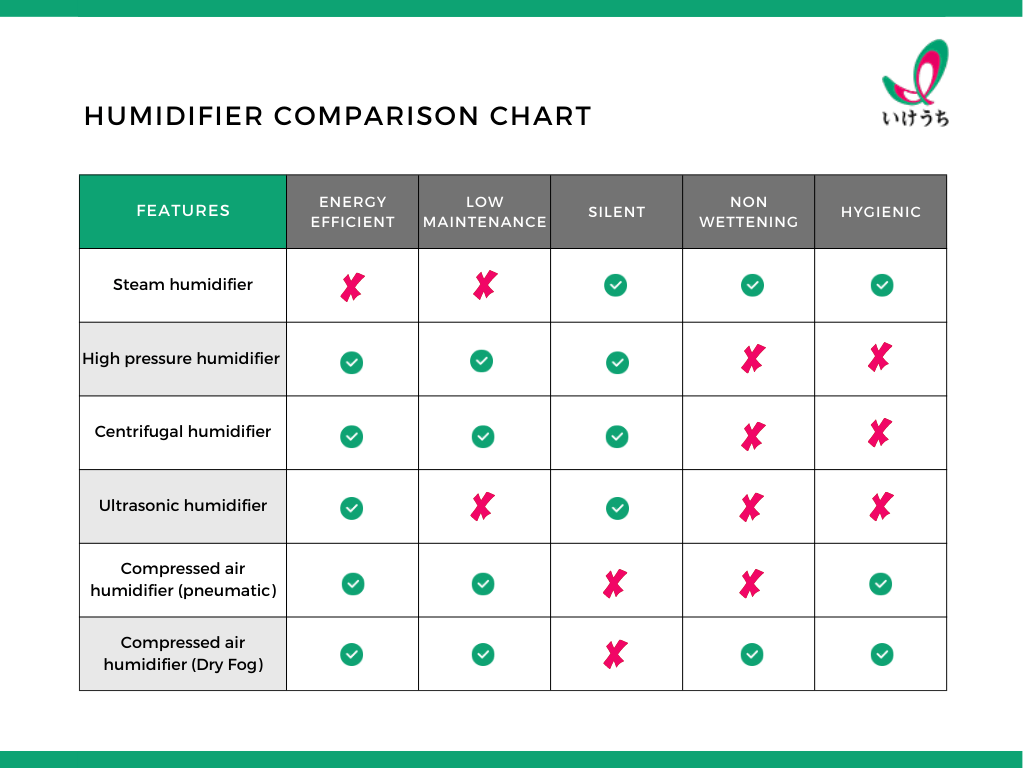
Steam humidification is in general more silent and will never wet the environment or the objects as no water droplets are sprayed. But the installation of the system will increase the air conditioning consumption and increase the operating costs.
Vaporizing humidification
Vaporising humidifiers are a more simple and cost efficient way to enforce humidification control. The downside is however that its very difficult to control the humidity levels with this option. An evaporative humidifier is generally located in a duct or air handling unit. Air flows through a continually moistened evaporative matrix and absorbs moisture as it does so. Some of the more well-known vaporizing humidification systems are:
- Air washer
- Drop osmosis
Air washer
The air washer method blows air with a higher level of humidity by spraying water in the air-conditioner. The advantage of this method is that its energy efficient and don’t wet due to no droplets. The disadvantage is however that its very difficult to control the humidity levels and frequent maintenance is needed.
Drop osmosis
The drop osmosis methods uses the air coming in from the outside and increase humidity by dropping water down as it passes. The advantages of this method is also its low cost and energy efficiency. It is however not possible to control the humidity level and there is a risk of bacteria and dirt entering the humidification element.
Adiabatic humidification
Adiabatic humidification is the term used to describe cool mist humidifiers. The principle is to release water droplets in the air using an external energy power. As water is sprayed without being heated beforehand like in isothermal, there is a decrease in temperature happening while humidifying. This is the adiabatic cooling effect.
There are different type of cool mist humidifiers on the market:
- Centrifugal humidifier
- Ultrasonic humidifier
- High pressure humidifier (with pressurized water)
- Compressed air humidifier (our Dry Fog humidifier)
Many advantages
Using a cool mist humidifier will decrease the costs of air conditioning and lower the operating costs. It also offers a double-edge advantage of humidifying while cooling the environment. And at the same time suppressing dust to reduce the airborne contamination. But between all the adiabatic humidification system, the compressed air Dry Fog humidifier offers the best alternative.
Why may a Dry Fog humidifier be the best solution?
While it uses osmosis water and compressed air, our AKIMist® can cover a larger area or be used for spot humidification. It has almost no maintenance and it will never leak thanks to its internal design.
But its most interesting feature is that it sprays non-wetting fog. Thanks to the small water droplets size, our AKIMist® humidifier will never wet the environment or the object.
Check out our infographic which compares the different types
Advantages of Dry Fog Humidification:
- Non-wetting
- Energy-efficient
- Low maintenance
- Hygienic
- Easy to install
- Dust suppression
AKIMist® “E” Dry Fog Humidifier
AKIMist® is unique for its non-wetting ability due to the extremely tiny droplet size around 7.5 µm – making it ideal for sensitive production environments.
How to choose an industrial humidification system
Selecting an industrial humidifier involves more than comparing purchase prices. The system must deliver enough moisture for your process, work with the available water supply and provide suitable control at an acceptable operating cost.
Estimate your humidification demand
Humidification demand is the amount of water that must be added to the air, usually expressed in kilograms per hour (kg/h). To estimate it, consider:
Target conditions: The temperature and relative humidity required by your material or process.
Incoming air: The temperature, moisture content and volume of outdoor or replacement air entering the building.
Ventilation and extraction: Air removed by extraction systems must be replaced, which can increase demand during dry weather.
Building conditions: Room volume, open doors and air leakage affect initial humidification and ongoing moisture losses.
Production: Materials and processes may absorb or release moisture.
Room size alone is not enough to determine the required capacity. A humidification calculation should account for the moisture difference between incoming air and target conditions, together with airflow and process requirements.
Assess your water quality
Water quality affects maintenance, equipment reliability and the potential for mineral deposits. Before selecting a system, obtain a water analysis covering hardness, conductivity and mineral content, and assess the relevant microbiological requirements.
Treatment requirements vary by technology. Atomizing systems may require reverse osmosis or demineralized water to limit mineral dust and nozzle deposits. Electrode steam humidifiers, by contrast, require water with suitable electrical conductivity.
Check the manufacturer’s water specifications and include treatment equipment, filter replacement, drainage and routine hygiene procedures in the installation plan.
Compare total operating costs
Compare systems at the same moisture output, operating hours and target conditions. Include:
- Electricity or fuel used by the humidifier.
- Compressor electricity for compressed-air systems.
- Pumps, fans and control equipment.
- Water supply, treatment and wastewater.
- Maintenance, consumables and replacement parts.
- Any additional heating or cooling required.
Adiabatic humidification cools the air as water evaporates. This can be useful where cooling is needed, but additional heating may be required in other conditions. Include this effect when comparing it with steam humidification.
Assess purchase and installation costs alongside annual operating costs over the expected service life. Ikeuchi can help evaluate your humidification demand, water requirements and installation conditions to identify a suitable solution.
catalog
Download our AKIMist® catalog to learn more about the technology behind dry fog
Related articles




Stay updated: Ikeuchi news & insights
"*" indicates required fields
Get expert advice:
contact us today
Would you like to know what Ikeuchi can do for your organization? We’re happy to discuss your needs and show how we can solve your challenges. You’ll receive a response from us within 24 hours!
"*" indicates required fields
Call us: +31 (0) 20 820 2175
- Global presence and experience
- The number 1 nozzle manufacturer in Japan
- Japanese Precision Technology
“High quality nozzles. Friendly and helpful customer service”
“With Ikeuchi spray nozzles we are able to save costs as we don’t need to replace them so often as before.”
“When it is about nozzle technology, IKEUCHI are the experts. We always highly appreciated their knowhow and their extremely wide range of nozzles, not to mention their unrivalled AKIMist humidifier”
“When it is about nozzle technology, IKEUCHI are the experts. ”