
Warping process
Ikeuchi provides an energy-efficient and non-wetting humidification solution for the warping process
Warping process
Warping refers to the process of arranging yarns or threads lengthwise on a loom. During warping, parallel threads are wound onto a beam in preparation for the weaving process. This step ensures that the threads are properly aligned and tensioned before weaving.
A critical point when it comes to warping, is maintaining the preservation of the yarn’s elongation at a constant level. If the warp beam does not consist of qualitative warp yarn, there is a possibility to disrupt the weaving performance.
In order to prevent this, Ikeuchi recommends to implement humidity control in the factory.
Highlights
- Humidity control
- Spot humidification
- Reduce ESD
- Reduce defects
- Increase quality
Improve the warping process with Dry Fog Humidity control
Humidity control
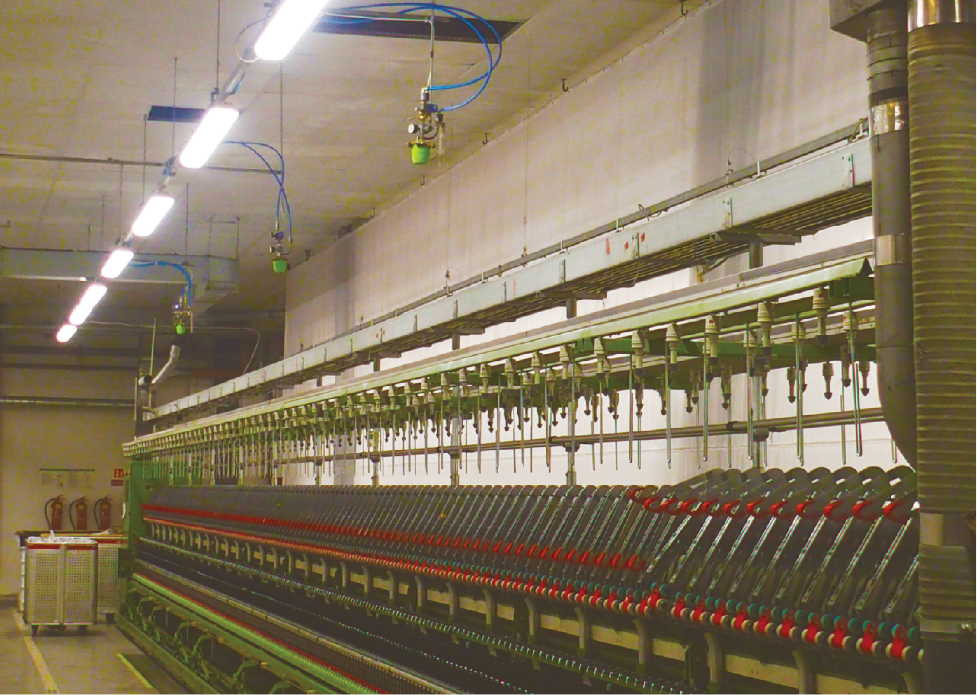
As the threads can be fragile during the warping process, moisture plays a major role in ensuring that the quality of the material remains resistant. With the implementation of the AKIMist “E” it is possible to spray “Dry Fog” to establish an optimal level of moisture and relative humidity. By doing so:
- The material maintains the material moist;
- The thread breakage caused by drying is prevented;
- It assist in catching any textile dust;and prevents dust from sticking on to the fiber.
- Reduce defects
- Increase product quality
- Reduce energy costs
- Decrease costs
FAQ regarding the warping process
1: What is the warping process in textiles?
Warping is the preparation of a set of parallel yarns for weaving. Yarn from multiple packages is wound onto a beam in a specified number, length and arrangement, with controlled tension.
2: What is the purpose of warping?
Warping prepares the lengthwise yarns, known as the warp, for subsequent processing and weaving. Accurate yarn alignment, consistent tension and uniform winding help produce a suitable beam and support efficient production.
3: What is the difference between direct and sectional warping?
In direct warping, yarns from a creel are wound directly onto a warping beam. Several beams may then be combined during subsequent processing. In sectional warping, yarns are wound in sections onto a drum before being transferred to a beam. The choice depends on the yarn, production requirements and fabric design.
4: What causes yarn breakage during warping?
Yarn breakage can result from excessive or uneven tension, yarn defects, friction, damaged guides or unsuitable operating conditions. Low humidity can also contribute to problems with some yarns. Identifying the cause is essential before adjusting the machine or introducing humidity control.
5: Why is humidity control important during warping?
Humidity influences yarn moisture content and electrostatic behaviour. For moisture-sensitive fibres, excessively dry air can affect processing performance. Suitable humidity control can help maintain more consistent conditions and reduce dryness-related yarn breakage and static problems.
6: What is the recommended humidity for the warping process?
There is no single relative humidity setting suitable for every warping operation. The appropriate level depends on fibre type, yarn properties, temperature, machine speed and production requirements. Setpoints should follow material and equipment guidance and be verified under actual operating conditions.
8: Can humidification help reduce static electricity during warping?
Maintaining suitable humidity can help reduce static build-up, particularly when processing moisture-absorbing fibres. Its effectiveness depends on the material and operating conditions. Grounding, equipment maintenance and dedicated static-control measures may also be necessary.
Related products
AKIMist® “E” Dry Fog Humidifier
AKIMist® is unique for its non-wetting ability due to the extremely tiny droplet size around 7.5 µm – making it ideal for sensitive applications like the warping process.
Case studies



Customer stories: real experiences, genuine satisfaction
“High quality nozzles. Friendly and helpful customer service”
“With Ikeuchi spray nozzles we are able to save costs as we don’t need to replace them so often as before.”
“When it is about nozzle technology, IKEUCHI are the experts. We always highly appreciated their knowhow and their extremely wide range of nozzles, not to mention their unrivalled AKIMist humidifier”
Experience the impact of Ikeuchi’s precision spray technology and innovative solutions through the voices of industries worldwide. See how we help businesses excel with custom-made solutions and unparalleled reliability.






Stay updated: Ikeuchi news & insights
"*" indicates required fields
Get expert advice:
contact us today
Would you like to know what Ikeuchi can do for your organization? We’re happy to discuss your needs and show how we can solve your challenges. You’ll receive a response from us within 24 hours!
"*" indicates required fields
Call us: +31 (0) 20 820 2175
- Global presence and experience
- The number 1 nozzle manufacturer in Japan
- Japanese Precision Technology
“High quality nozzles. Friendly and helpful customer service”
“With Ikeuchi spray nozzles we are able to save costs as we don’t need to replace them so often as before.”
“When it is about nozzle technology, IKEUCHI are the experts. We always highly appreciated their knowhow and their extremely wide range of nozzles, not to mention their unrivalled AKIMist humidifier”
“When it is about nozzle technology, IKEUCHI are the experts. ”