
Fog Dust Suppression: How Fine Water Mist Captures Airborne Dust
Dust is a persistent challenge in many industrial environments. From recycling plants and mining facilities to manufacturing factories and bulk material handling operations, airborne dust can affect air quality, employee health, machinery and the surrounding environment. One effective way to tackle this problem is with fog dust suppression.
Instead of using large amounts of water to wet dusty materials, fog-based dust suppression uses finely atomised water droplets to interact with airborne dust particles. When correctly designed, these systems can capture dust before it spreads, while minimising unwanted wetting of machinery, products and surrounding surfaces.
But how does dust suppression with fog actually work? What makes droplet size so important? And which type of fog system is suitable for different industrial applications? In this article, we explain the science behind fog dust suppression and explore how Ikeuchi’s spray nozzle technology can help industries control airborne dust.
What Is Fog Dust Suppression?
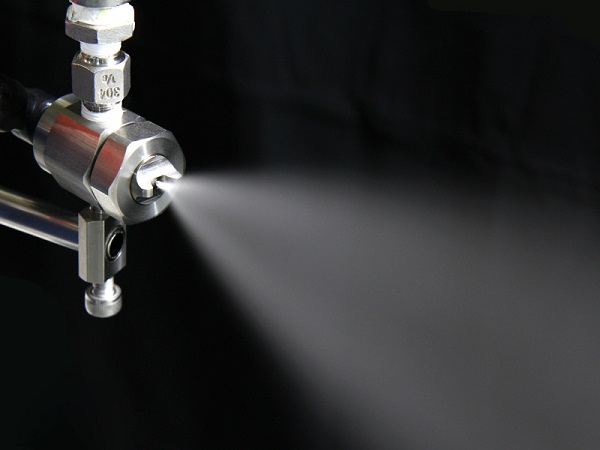
Fog dust suppression is a dust control technique that uses fine water droplets to capture airborne dust particles and reduce their dispersion. A specially designed spray nozzle atomises water into small droplets, creating a fine mist or fog. These droplets spread through the air and interact with suspended dust particles.
When a water droplet collides with a dust particle, the particle can adhere to the droplet. The combined particle becomes heavier and can settle under gravity, helping reduce the amount of airborne dust. Unlike conventional water spraying, which often focuses on wetting surfaces or materials, fog-based dust suppression targets particles suspended in the air.
This makes it particularly interesting for industrial processes where dust is continuously generated and where excessive water application is undesirable.
How Does Dust Suppression with Fog Work?
The effectiveness of fog dust suppression depends on the interaction between water droplets and airborne dust particles. The process involves several important stages.
1. Generating fine water droplets
The first step is producing a controlled spray of small water droplets. Specialised pneumatic or hydraulic spray nozzles atomise water into droplets of different sizes, depending on the technology and operating conditions. For example, Ikeuchi’s BIM series produces fine droplets ranging from approximately 10 to 100 µm, while the AKIMist® technology produces dry fog with droplets around 7.5 µm.
2. Bringing droplets into contact with airborne dust
Once released, the fine droplets disperse into the surrounding air. As they travel through the dusty environment, they can collide with suspended particles. The objective is to create sufficient contact between the fog and the airborne dust so that particles can be captured effectively.
3. Increasing the weight of dust particles
When a dust particle attaches to a water droplet, the combined particle becomes heavier. This can encourage the particle to settle rather than remain suspended in the air. The effectiveness of this process depends on factors such as droplet size, dust particle characteristics, airflow, spray distribution and system positioning.
4. Reducing dust dispersion
By capturing airborne particles close to their source, fog systems can help prevent dust from spreading into surrounding work areas or escaping into the outdoor environment. This is particularly valuable in industrial facilities where dust is generated continuously during production or material handling.
Why Is Droplet Size Important for Dust Suppression?
Droplet size is one of the most important factors when designing an effective fog dust suppression system.Water droplets that are too large may fall quickly, wet surfaces and materials, and provide insufficient contact with airborne dust.
On the other hand, very small droplets can remain suspended in the air for longer and interact with fine airborne particles. The optimal droplet size depends on the dust being generated and the environment in which the system operates. For this reason, choosing the right spray nozzle is essential.
Fine fog versus conventional water spraying
Conventional water sprays often use relatively large droplets to wet dusty materials and prevent dust from becoming airborne. Fog-based systems take a different approach by creating smaller droplets that can disperse through the air and interact with suspended dust particles.
The main difference is the objective:
Conventional water spraying primarily wets the material or surface.
Fine fog aims to capture dust particles suspended in the air.
Dry fog is designed to control dust while minimising surface wetting.
Selecting the right technology depends on the industrial application, dust characteristics and acceptable moisture levels.
Dry Fog Dust Suppression: Controlling Dust Without Wetting Surfaces
In certain industrial environments, adding moisture to machinery, materials or products is not desirable. This is where dry fog dust suppression becomes particularly useful. Dry fog consists of extremely small water droplets that can remain suspended in the air and humidify the surrounding environment without significantly wetting surfaces when correctly applied. Ikeuchi’s AKIMist® technology produces droplets of approximately 7.5 µm. These very fine droplets are designed to suppress airborne dust while minimising surface wetting.
Dry fog can be particularly suitable for:
Manufacturing facilities.
Electronics production.
Textile processing.
Paper and printing industries.
Indoor production environments.
Facilities with sensitive machinery.
Besides capturing airborne dust, maintaining an appropriate humidity level can also help reduce static electricity and the associated attraction of dust to surfaces. For manufacturers looking to improve air quality without introducing excessive moisture, dry fog offers an interesting alternative to conventional humidification and dust suppression methods.
Industrial Applications of Fog Dust Suppression
1. Dust Suppression in Recycling Plants
Recycling facilities generate dust during sorting, shredding, crushing and material transportation. Fine dust can spread throughout the facility and negatively affect the working environment. Installing fog nozzles near dust-generating processes can help capture airborne particles before they disperse.
2. Dust Suppression in Mining and Quarrying
Mining and quarrying operations generate significant amounts of dust during crushing, screening, loading and transportation. Fog systems can be installed around crushers, conveyor belts, transfer points and material storage areas. For larger industrial spaces and outdoor environments, pneumatic spray nozzles can generate a fine mist over a relatively large area.
3. Dust Control in Coal Storage Facilities
Coal storage and handling operations can generate airborne dust that escapes into the surrounding environment. Fog-based dust suppression can help reduce this dispersion by capturing particles before they are carried away by wind. In one application at a coal storage facility, Ikeuchi implemented a fog-based dust control system using BIMJ spray nozzles.
The fine mist helped settle airborne coal dust, significantly reducing dust escaping from the site. The installation also improved the working environment and eliminated complaints from neighbouring residents. This illustrates how properly designed fog systems can help address both operational and environmental dust challenges.
4. Dust Suppression in Manufacturing Facilities
Manufacturing processes can generate fine dust that affects product quality, machinery and employee working conditions. In environments where wetting must be avoided, dry fog technology can be an attractive solution. AKIMist® can be used to introduce extremely fine droplets into the production environment, helping suppress dust while maintaining controlled humidity levels.
5. Dust Control in Pulp and Paper Industries
Paper manufacturing and processing can generate dust and fibres that circulate throughout production facilities. Dry fog humidification can help manage airborne dust and maintain suitable humidity levels. This can be particularly useful in processes where excessive moisture could affect the material or production equipment.
Which Fog Technology Is Best for Dust Suppression?
Not every industrial dust problem requires the same type of fog. The right technology depends on the size of the area, dust particle characteristics, required moisture levels and the location of the dust source. At Ikeuchi Europe, different spray nozzle technologies can be considered depending on these requirements.
BIM Series: Fine Fog for Larger Areas
The Ikeuchi BIM series consists of pneumatic spray nozzles designed to produce fine atomisation. Depending on the configuration, the nozzles generate droplets in the approximate range of 10–100 µm. This makes them suitable for applications where airborne dust needs to be controlled across larger spaces or around industrial processes.
Typical applications include:
Coal storage facilities.
Mining operations.
Conveyor belt transfer points.
Crushing and screening installations.
Outdoor dust control.
Industrial material handling.
The BIM series can create a fine fog that helps capture airborne particles without significantly wetting the surrounding environment.
AKIMist®: Dry Fog for Sensitive Environments
For applications where surface wetting must be minimised, IKEUCHI offers the AKIMist® dry fog humidification system.
AKIMist® produces droplets of approximately 7.5 µm.
Due to their extremely small size, the droplets can remain suspended in the air and suppress airborne dust without significantly wetting surfaces under suitable operating conditions.
The system is particularly suitable for indoor industrial environments where humidity control and dust suppression are both important.
Applications include:
Electronics manufacturing.
Automotive production.
Textile factories.
Paper processing.
General manufacturing facilities.
By combining humidity control with dust suppression, AKIMist® can help create a more controlled production environment.
Benefits of Using Fog for Industrial Dust Suppression
Using fog rather than conventional water spraying can offer several advantages, depending on the application.
Reduced airborne dust
Fine water droplets can capture airborne particles and help reduce dust dispersion.
Less unwanted wetting
Correctly selected fog systems can reduce the amount of water reaching machinery, products and surrounding surfaces.
Improved working environments
Reducing airborne dust can help create cleaner and more comfortable industrial working environments.
Protection of sensitive processes
Dry fog technology is particularly interesting for manufacturing processes where excessive moisture is undesirable.
Flexible installation possibilities
Fog nozzles can be installed near individual dust sources or integrated into larger industrial dust control systems.
Water-efficient dust control
By selecting the appropriate atomisation technology and spray volume, fog systems can provide targeted dust control without relying solely on large-volume water spraying.
Before selecting a fog system, it is important to understand the characteristics of the dust and the environment.
Consider the following questions:
What type of dust needs to be controlled?
How fine are the airborne particles?
Is the dust generated continuously or intermittently?
Is the application indoors or outdoors?
How large is the area that needs to be treated?
Is surface wetting acceptable?
What are the airflow and ventilation conditions?
Where should the nozzles be installed for optimal coverage?
These factors influence nozzle selection, droplet size, spray capacity, installation layout and operating pressure. A professional assessment is recommended to determine the most suitable technology.
Why Choose Ikeuchi for Fog Dust Suppression?
Ikeuchi specialises in high-precision spray nozzle technology and industrial humidification systems. With extensive experience in spray technology, Ikeuchi develops solutions for a wide range of industrial applications. For dust suppression, the focus is on selecting the appropriate spray technology to match the dust characteristics and operational requirements. Whether the application requires fine fog for larger industrial areas or dry fog for sensitive indoor environments, Ikeuchi can help identify a suitable solution. The objective is not simply to generate fog, but to create an effective and reliable system that addresses the specific dust control challenge.
Looking for an Effective Fog Dust Suppression Solution?
Related articles


Get expert advice:
contact us today
Would you like to know what Ikeuchi can do for your organization? We’re happy to discuss your needs and show how we can solve your challenges. You’ll receive a response from us within 24 hours!
"*" indicates required fields
Call us: +31 (0) 20 820 2175
- Global presence and experience
- The number 1 nozzle manufacturer in Japan
- Japanese Precision Technology
“High quality nozzles. Friendly and helpful customer service”
“With Ikeuchi spray nozzles we are able to save costs as we don’t need to replace them so often as before.”
“When it is about nozzle technology, IKEUCHI are the experts. We always highly appreciated their knowhow and their extremely wide range of nozzles, not to mention their unrivalled AKIMist humidifier”
“When it is about nozzle technology, IKEUCHI are the experts. ”