
How does an air atomizing spray nozzle work?
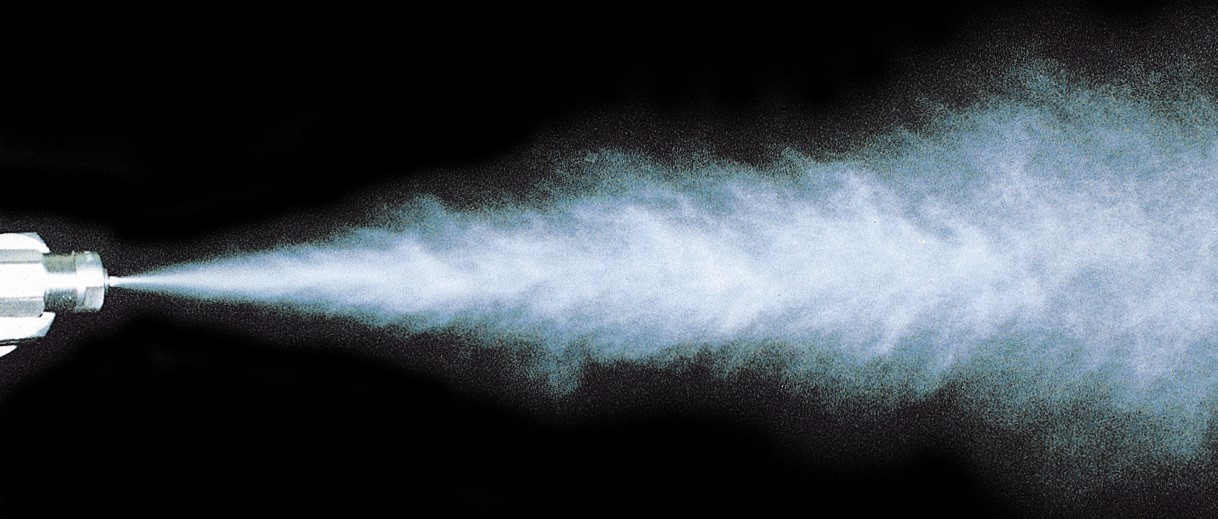
An air atomizing spray nozzle uses compressed air to break a liquid into very fine droplets. By combining liquid and compressed air, the nozzle produces a finely atomized spray that can achieve smaller droplet sizes than conventional hydraulic spray nozzles.
Depending on the nozzle design, the air and liquid can mix either inside or outside the nozzle. The compressed air creates the energy needed to break the liquid into droplets, allowing precise control over the spray characteristics.
Air atomizing nozzles are commonly used in industrial applications that require fine atomization, accurate liquid distribution or adjustable spray flow rates. They can be characterized by these 3 distinctive features:
The 3 features
- Excellent atomizing performance
An air atomizing spray nozzle is capable of producing fine atomization with a mean droplet diameter of 10 μm or less, which is difficult with hydraulic spray nozzles. - Large turn-down ratio
Air atomizing spray nozzles have large turn-down ratios of spray flow-rate with little variation in droplet size and spray distribution. This makes them ideal for spray flow adjustable nozzles. - Large free passage diameter
Air atomizing spray nozzles have larger free passage diameters than hydraulic spray nozzles, which is effective for reducing clogging problems
Air atomizing vs. hydraulic spray nozzles
When selecting a spray nozzle for an industrial application, it is important to understand the differences between air atomizing and hydraulic spray nozzles. Although both technologies are designed to disperse liquids into droplets, they use different methods to achieve atomization, resulting in different spray characteristics and performance.
Air atomizing spray nozzles use compressed air to break the liquid into fine droplets, whereas hydraulic spray nozzles rely solely on liquid pressure to create the spray. The choice between these two technologies depends on factors such as the required droplet size, liquid flow rate, available operating pressure and specific application requirements.
Below, we compare the main characteristics of both nozzle types to help you determine which technology is best suited to your application.
Feature | Air atomizing nozzle | Hydraulic nozzle |
|---|---|---|
Atomization | Uses compressed air | Uses liquid pressure |
Droplet size | Very fine droplets possible | Depends on pressure and nozzle design |
Air supply | Required | Not required |
Flow adjustment | Often offers a wide turndown ratio | Depends on nozzle design |
Typical applications | Fine spraying, humidification, coating | Cleaning, cooling, washing |
Applications of air atomizing spray nozzles
When selecting a spray nozzle for an industrial application, it is important to understand the differences between air atomizing and hydraulic spray nozzles. Although both technologies are designed to disperse liquids into droplets, they use different methods to achieve atomization, resulting in different spray characteristics and performance.
Air atomizing spray nozzles use compressed air to break the liquid into fine droplets, whereas hydraulic spray nozzles rely solely on liquid pressure to create the spray. The choice between these two technologies depends on factors such as the required droplet size, liquid flow rate, available operating pressure and specific application requirements.
Applications
- Industrial humidification
- Surface coating and lubrication
- Cooling and temperature control
- Fine spraying and liquid distribution
- Dust suppression
- Chemical spraying
What types of liquids can be sprayed?
- Water
- Deodorant
- Alcohol
- Aqueous ammonia
- Anti-electrostatic agent
- Surface treatment agent
What type of gas can be applied?
- Compressed air (most common)
- N2
- Steam
Advantages of air atomizing spray nozzles
Air atomizing spray nozzles offer several advantages for industrial spraying applications. By combining compressed air and liquid, they can produce very fine droplets and achieve excellent atomization. Depending on the nozzle design, different air-liquid mixing systems provide flexibility in spray performance. Other key advantages include a wide turndown ratio, allowing liquid flow rates to be adjusted to meet changing process requirements, and an adjustable air-to-liquid ratio, which helps optimise droplet size and atomization performance for specific applications.
Air liquid mixing systems for excellent atomization
Internal mixing type
Compressed air and liquid are mixed inside the nozzle and atomized. The internal mixing type can be either inner air type, outer air type or pre-mix type.
Compressed air flows in the center of the nozzle, while liquid flows along its circumference. This type provides an important benefit with a larger free passage diameter which minimizes clogging.
Liquid flows in the center of the nozzle, while compressed air flows along its circumference. This type of nozzle is selected for wide range of applications. Larger orifice size can be designed on demand while the spray droplets become a little coarser.
Even at a low air-water ratio, the increased velocity of the droplets results in a strong impact force. Furthermore, the turn-down ratio is larger and this type is suitable for cooling objects in high temperature range.
External mixing type
Compressed air and liquid are mixed outside the
nozzle. Hence, this type clogs the least. This is also
classified into inner air type and outer air type.
Impinging type
Air-stream entraining fine fog jets out from the
nozzle and impinges against another air-stream of
the same nature for shattering the fog into even
finer, more-uniform droplets. This is an original invention by Ikeuchi. Read more here: AKIMist
Turn-down ratio
The turn-down range is a range of adjustable spray capacity, and the ratio of its minimum to maximum spray capacity is referred to as the turn-down ratio.
To cover a wide range of spray capacity with a single nozzle, it is not practical to use a hydraulic spray nozzle because it requires a huge pressure increase (❶ in the figure). Air atomizing spray nozzles (pneumatic spray nozzles) are adjustable in both air and liquid pressures, allowing adjustment of the spray capacity with minimum pressure change (❷ in the figure). Thus, air atomizing spray nozzles are suitable for cooling combustion gases and other applications that require nozzles with small spray droplet sizes and a large turn-down ratio
Air-to-liquid ratio
Air-to-liquid ratio is the rate of air consumption divided by spray capacity. The ratio can be expressed in both volume and weight ratios. For the same nozzle, a higher air-water ratio will result in a smaller spray droplet size. The air-water ratio in this catalog is expressed as the volume ratio unless otherwise specified.
How to select the right air atomizing spray nozzle
Selecting the right air atomizing spray nozzle is essential to achieving optimal spraying performance and ensuring a reliable and efficient production process. The best nozzle for your application depends on several factors, including the required spray pattern, the liquid feeding system and the materials used in the nozzle construction. By taking these factors into account, you can find a nozzle that meets your specific process requirements and provides consistent atomization performance.
Spray pattern
Spray pattern means the cross sectional shape of the spray. As illustrated, spray patterns are available in cone spray (hollow cone spray and full cone spray), flat spray, and liquid film-like spray. It is important to select a spray pattern suited for each application, thus, delivering the optimal nozzle performance.
A hollow cone spray pattern is suitable for applications where you wish to achieve a ring-shaped distribution with minimal liquid in the center. Applications include humidification, gas scrubbing, dust control, and moisture control.
A full cone spray pattern is suitable for applications where you wish to achieve an even spray distribution in a wide spray distribution. Applications include humidification, conveyor belts, car wash, pollution control, and moisture control.
A flat spray pattern is suitable for applications where you wish to achieve a mountain-shaped distribution. Applications include cooling and coating.
A film-like spray pattern is suitable for applications where you wish to achieve a uniform distribution. Applications include cooling and coating.
Droplet size
One of the main advantages of air atomizing spray nozzles is their ability to produce very fine droplets. By using compressed air to break up the liquid, these nozzles can achieve smaller droplet sizes than many conventional hydraulic spray nozzles. The actual droplet size depends on several factors, including air pressure, liquid pressure, air-to-liquid ratio, liquid properties and nozzle design.
In chemical processes such as cooling, evaporation, combustion and drying, the surface-to-volume ratio, i.e. specific surface area, is used to determine the efficiency. Because the rate of reaction is influenced more by a small number of large droplets than a large number of small droplets, it is advisable to use the Sauter Mean Diameter as a representative value for the droplet size.
Liquid feeding system
Liquid pressure system
In a liquid pressure type system, the liquid is supplied under pressure, while compressed air is used to further break it into fine droplets. The liquid pressure and air pressure can be adjusted independently to achieve the desired spray flow rate and atomization performance. This type of system is suitable for applications requiring a stable liquid supply, precise flow control and fine atomization.
Liquid siphon system
In a siphon-type system, the liquid is drawn into the nozzle by the suction effect (Venturi effect) created by the compressed air. This allows the nozzle to draw liquid from an unpressurised container or tank without requiring a separate liquid pump. The amount of liquid supplied depends on factors such as the air pressure, liquid properties and the height difference between the nozzle and the liquid source. Siphon-type nozzles are particularly suitable for applications requiring relatively low liquid flow rates and a simple liquid feeding system.
Materials
Choosing the right material for an air atomizing spray nozzle is important to ensure durability, reliability and resistance to corrosion and wear. The most suitable material depends on the liquid being sprayed, operating conditions and the environment in which the nozzle is used. Factors such as chemical compatibility, temperature, pressure and potential abrasion should be considered when selecting the nozzle material. Common materials include stainless steel, brass and engineering plastics, each offering different properties and benefits. Selecting the appropriate material helps extend nozzle service life, minimise maintenance and ensure consistent spraying performance. Below, a table can be seen with the chemical resistance of many of the more common spray nozzle materials.

Take a look at our selection of air atomizing nozzles
Advantages of air-atomizing nozzles
- Excellent atomizing performance
- Large turn-down ratio
- Large free-passage diameter
Related articles




Stay updated: Ikeuchi news & insights
"*" indicates required fields
Get expert advice:
contact us today
Would you like to know what Ikeuchi can do for your organization? We’re happy to discuss your needs and show how we can solve your challenges. You’ll receive a response from us within 24 hours!
"*" indicates required fields
Call us: +31 (0) 20 820 2175
- Global presence and experience
- The number 1 nozzle manufacturer in Japan
- Japanese Precision Technology
“High quality nozzles. Friendly and helpful customer service”
“With Ikeuchi spray nozzles we are able to save costs as we don’t need to replace them so often as before.”
“When it is about nozzle technology, IKEUCHI are the experts. We always highly appreciated their knowhow and their extremely wide range of nozzles, not to mention their unrivalled AKIMist humidifier”
“When it is about nozzle technology, IKEUCHI are the experts. ”